

Career advice for where you are right now.
One advisor for every stage: graduating, growing, leading, switching fields or returning to work. It reads your background, maps realistic paths and gives you a plan you can start this week.
Five stages. One advisor.
The advice a graduate needs is not the advice a career switcher needs. Pick the one that describes your next move.
Final year to first job
From degree to first job, without the guesswork.
You have studied hard and you are not sure what it qualifies you for. Every posting asks for experience you have not had the chance to get yet.
What the advisor does
- Translates coursework, projects and internships into the skills employers search for
- Shortlists entry-level roles that hire from your background
- Shows where each of those roles typically leads
- Builds a first resume from projects when there is no work history
You leave with
- A shortlist of realistic first roles
- A projects-first resume
- A plan for your first applications
Where this stage goes next
0 to 3 years in
Turn a first job into a direction.
You took the first offer that came. You can do the job now, and you are no longer sure it is the one you want to be doing in five years.
What the advisor does
- Reads your first roles for the strengths they actually show
- Compares the paths open from here: specialise, broaden, or change company
- Names the two or three skills between you and the next level
- Sets a twelve-month plan with checkpoints
You leave with
- A direction, with reasons
- A skills plan for the next level
- A resume that shows growth
Where this stage goes next
4 or more years in
Move up, not just along.
You are good at what you do and the next step is not obvious: a bigger title, a different company, people management, or a specialism.
What the advisor does
- Places your level and pay against the market for your role
- Maps the routes to senior, lead and management roles from where you stand
- Rewrites achievements as outcomes a hiring panel can weigh
- Prepares the case for an internal promotion or an external move
You leave with
- A level and pay benchmark
- A route to your next title
- An outcomes-led resume
Where this stage goes next
New field, same you
Change careers without starting from zero.
You have built real experience. It just does not have your target job’s title on it yet, and your resume is written in the vocabulary of the field you are leaving.
What the advisor does
- Finds the experience that transfers, which is usually more than you expect
- Restates it in the terms your target field uses
- Shows where you can realistically land now, not after a fantasy leap
- Ranks the gaps worth closing before you apply
You leave with
- A transfer map of your skills
- Target roles you can land now
- A step-by-step switch plan
Where this stage goes next
After a career break
Come back at the level you left.
You stepped away for family, health, study or a venture of your own. The gap is the first thing a recruiter sees, and you are not sure how much has changed.
What the advisor does
- Frames the break plainly, in a line a recruiter can accept
- Updates your skills picture against what the role asks for today
- Finds roles and employers open to returning professionals
- Plans the refresh: what to relearn first, and what can wait
You leave with
- A clear way to explain the gap
- A refresh plan
- Roles open to returners
Where this stage goes next
The same method, whichever stage you chose
The questions change with the stage. The way the advisor gets to an answer does not.
- 01
Tell it where you are
Pick your stage and share your education, roles and projects. A resume is enough to start.
- 02
Take the work-style assessment
A short set of questions about how you naturally work. There are no right answers.
- 03
See your realistic paths
Roles that hire from your background, each with the reason it fits and where it leads.
- 04
Get the plan
The gaps between you and each role, ranked, with the order to close them in.
It starts with how you actually work.
Before it suggests a single role, the advisor asks how you prefer to work: alone or in a group, with structure or without, in depth on one thing or across many. Your answers become a work-style profile, and every recommendation after that is checked against it.
A few minutes, in one sitting
Short enough to finish, specific enough to be useful.
A profile, not a horoscope
How you operate at work, described in plain terms.
Strengths and blind spots
What you bring, what to watch for, and the trade-offs of each direction.
Moving from non-IT to IT is a translation, not a restart.
Most of what you have done carries across. The problem is that it is written in the vocabulary of your old field, so nobody in the new one recognises it. The same holds for a move between departments or functions. These are the kinds of moves the advisor maps.
- Coming fromCustomer support or BPOCan move intoIT service desk, QA testing, customer successWhat transfersTicket handling, troubleshooting, client communicationWhat to addTesting basics, SQL, a ticketing tool
- Coming fromMechanical or civil engineeringCan move intoData analysis, CAD automation, technical project coordinationWhat transfersProblem solving, reading specifications, working to toleranceWhat to addPython, SQL, a BI tool
- Coming fromBanking and finance operationsCan move intoBusiness analysis, fintech operations, product supportWhat transfersProcess knowledge, compliance, reconciliationWhat to addRequirements writing, SQL, agile basics
- Coming fromTeaching and trainingCan move intoInstructional design, learning and development, edtech customer successWhat transfersExplaining complex ideas, curriculum planning, assessmentWhat to addAuthoring tools, LMS basics, learner analytics
- Coming fromSales and business developmentCan move intoSaaS sales, pre-sales, account managementWhat transfersPipeline discipline, negotiation, client relationshipsWhat to addProduct demos, a CRM, basic cloud concepts
Examples of common transitions. Your own map is built from your background, and it will say so plainly when a move needs training first.
See the Career Advisor in action
From choosing a stage to a shortlist of roles and a ninety-day plan, in under a minute.
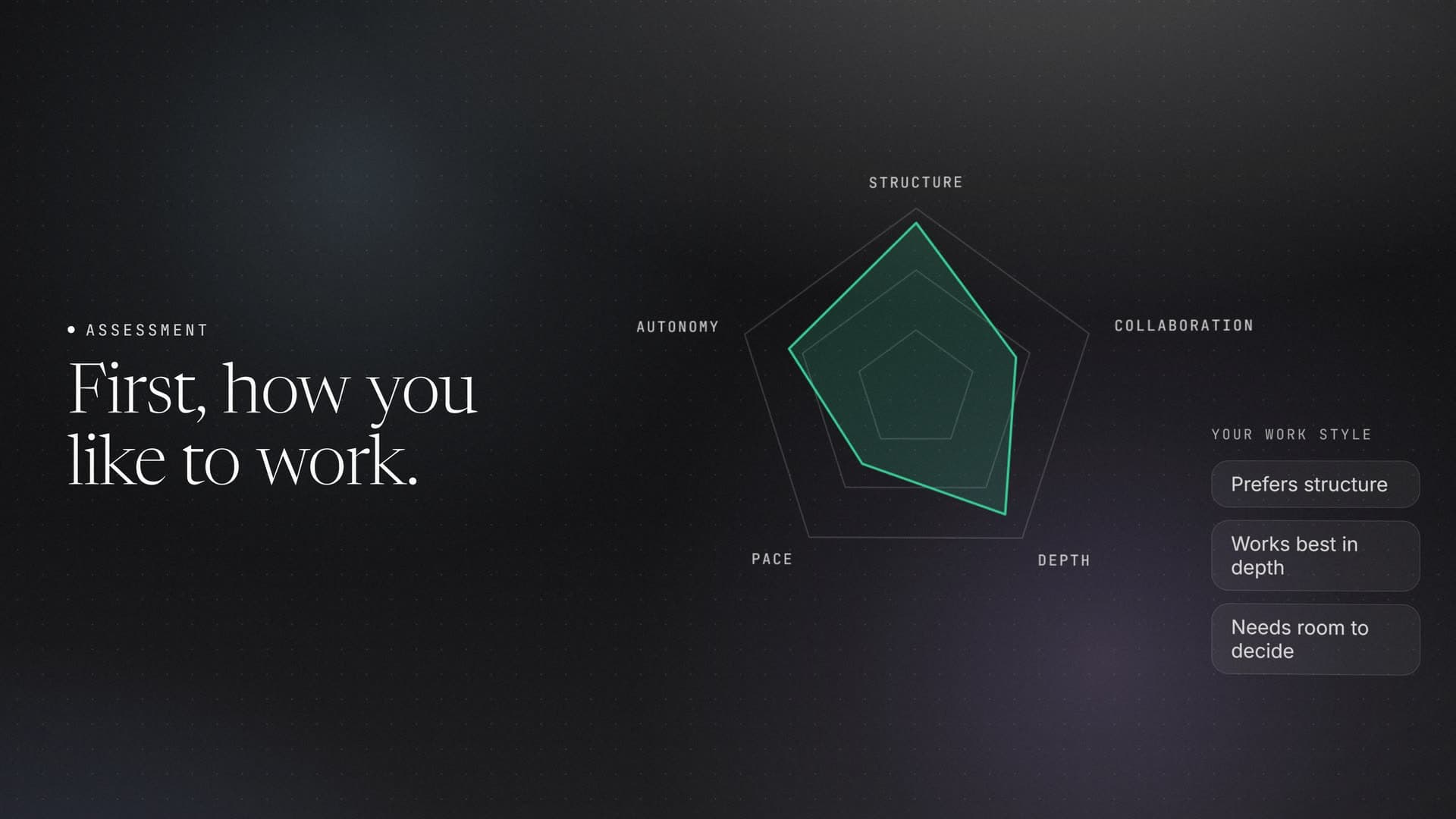
From your stage and work style to a shortlist of roles and a ninety-day plan.
From your stage and work style to a shortlist of roles and a ninety-day plan.
What you leave with
Five things, in the order you will use them.
- 01A work-style profileHow you operate, and the environments that suit it.
- 02A role shortlist, with reasonsEach role comes with why it fits and where it leads.
- 03A skills gap planThe specific gaps for each role, ranked by what matters most.
- 04A reframed resumeYour history, retold for the role you want next.
- 05A 30, 60 and 90 day planWhat to do first, so “someday” becomes a sequence.
Prefer to talk it through?
The advisor is software. When you want a person, career counselling is part of Placement Support, and the training team can tell you which program closes the gaps the advisor found.
Get My Career PlanQuestions that need a human?
The answers here cover the basics. For anything about your own search, your data, or a plan that fits your situation, send us the messy version. A real person replies.
Same day
Typical first reply
A person
Answers every message
- Hours
- Weekdays, 9:00 to 18:00 IST
- services@theudyog.ai
Power Up with the Rest of THE UDYOG
Combine this with the other services to run your job search from first application to signed offer.
Register once. Your search runs from there.
Share your profile and the roles you want. Matched jobs are found, tailored and applied to for you, with a team beside you for training and placement.
No card required to begin. Cancel anytime.